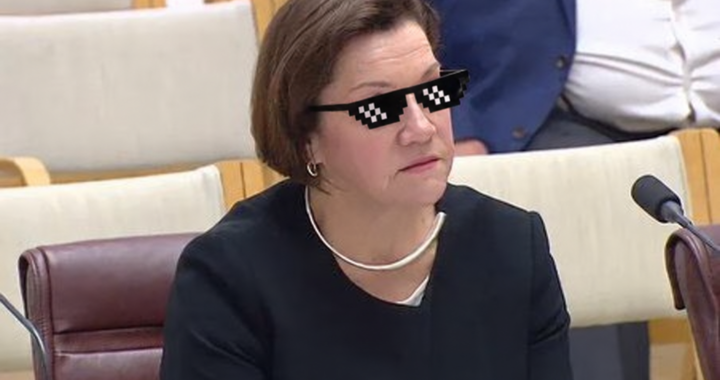
On 4 September 2026, something peculiar happened during a public hearing of an Australian Senate committee. Celia Perkins, a deputy secretary at the Department of Defence, ended her opening statement by noting that the officials present were willing to answer questions, but did not consent to their evidence being reposted on social media or their likenesses being reproduced outside the parliamentary setting. The committee declined the request. The proceedings were public, and public evidence could not simply be withdrawn from public circulation once it became inconvenient.
What initially looked like an unusual intervention by one department soon turned out to belong to a broader discussion. Australia’s Secretaries Board, which brings together the heads of federal government departments, had raised similar concerns with the Parliamentary Joint Committee on Parliamentary Standards. Its submission warned that excerpts from committee hearings could be stripped of context and circulated online in ways that exposed officials to “ridicule, hostility or abuse”. The proposed response was not to make parliamentary proceedings secret, but to exert greater control over what happened to their audiovisual material after publication.
This is what might be called memefiltering: the attempt by an institution to regulate the secondary life of its public output once that output enters an environment governed by clipping, remixing, repetition and ridicule.
The concern is understandable. A parliamentary hearing no longer exists only as a hearing. It also exists as a collection of potential fragments. A hesitation, contradiction, raised eyebrow, verbal mistake or awkward silence can be removed from hours of proceedings and turned into a self-contained media object. Once clipped, it can be captioned, slowed down, repeated, placed beside another image, turned into a reaction GIF or incorporated into an entirely different argument. The institution produces a record, but platforms make that record available for another form of production.
The problem is not limited to Australia. The British Parliament, for example, places explicit conditions on the reuse of footage from parliamentlive.tv. Its terms allow parliamentary material to be used for fair and accurate reporting while prohibiting its use for “satire, ridicule, or denigration”, alongside restrictions on misleading editing and decontextualisation. What appears at first to be a conventional copyright or broadcasting rule is also an attempt to distinguish legitimate circulation from illegitimate transformation.
That distinction has become increasingly difficult to maintain because digital culture rarely treats media as finished. Images and recordings function as raw material. Their value does not end with the event they document. They remain available for extraction and recombination, and those derivative versions can acquire a reach far greater than the source itself.
This produces an important split between two kinds of value. A parliamentary exchange has institutional value because it contains testimony, scrutiny, documentation and evidence. But the same exchange may also contain memetic value: editability, recognizability, emotional intensity or the ability to survive when detached from its original context. These forms of value do not necessarily correspond. A twenty-minute explanation may be far more informative than a two-second facial expression, yet the expression can travel through a network with almost no friction while the explanation does not.
Ridicule becomes significant within this system because it is unusually easy to circulate and unusually difficult to correct. A factual mistake can, at least in principle, be answered with another fact. A statistic can receive context. A joke, humiliating image or successful caricature operates differently. The correction may arrive after the image has already established its meaning, or it may simply become further material for the same joke.
This does not mean that memes are somehow inherently false. A short fragment can expose something a long official transcript obscures, just as an apparently complete record can still frame an event selectively. The important distinction is that institutional communication and memetic communication optimize for different things. Archives value completeness, traceability and contextual stability. Feeds reward compression, recognizability and transmission. Memefiltering emerges when institutions try to impose the logic of the archive on the logic of the feed.
From a Kekonomics perspective, the interesting part begins once these fragments enter systems of conversion. A clip attracts reactions; reactions increase circulation; circulation generates attention. That attention can then be translated into political visibility, followers, media coverage, donations, advertising revenue, cultural recognition or reputational damage. The meme does not need to have a literal cash price to participate in an economy. What matters is that its value is convertible.
This also explains why the Australian use of the word “ridicule” is so revealing. Ridicule is not simply unwanted commentary. It is one of the mechanisms through which an image acquires portability. An official may regard a five-second fragment as an unacceptable distortion of an hour-long hearing, but from the perspective of the platform that reduction is precisely what makes the material efficient. Context tends to increase informational accuracy while often decreasing memetic fitness.
Once institutions recognize this, they begin to anticipate not only how an event will be reported, but how it might be clipped. The distinction matters. Traditional media management tries to influence interpretation of a statement. Memefiltering tries to anticipate the transformation of the statement into a different kind of object altogether. Which facial expression will be isolated? Which sentence can survive without its qualification? Which pause can become a reaction image? What happens when footage intended as documentation becomes a template?
At that point the institution has already begun thinking within the meme economy, even while trying to resist it.
There is another reason why memefiltering is unstable. Attempts to prevent or regulate circulation can themselves become highly effective material for circulation. The Australian controversy demonstrated this almost immediately. A request intended to limit the reuse of parliamentary footage became news because such a limitation had been requested. Senators discussed it, journalists reported it and commentators circulated the relevant exchanges. An effort to control the secondary life of one media object had created another.
This resembles the familiar Streisand effect, but the dynamic is slightly different. In the classic Streisand effect, an attempt to suppress information increases attention to the information itself. Memefiltering can go further: the act of filtering becomes a new cultural object independent of whatever was originally supposed to be contained. The response generates additional material. The filter itself becomes content.
Restrictions can also create a form of memetic arbitrage. If official institutions privilege complete proceedings while platforms reward fragments, there is value in moving material from one environment into the other. Politicians, journalists, activists, partisan accounts and anonymous shitposters all perform versions of this work. They search through institutional media, identify the fragment most capable of circulating, edit it into platform-native form and release it into a different attention economy. The source material is often freely available. The labour lies in selection, timing, framing and recognition.
Seen this way, parliamentary archives have inadvertently become enormous repositories of potential platform content. Memefiltering is the moment at which the institution notices what is happening downstream.
The most consequential effects appear when circulation begins producing durable political characters. Repetition can turn one hesitation into a reputation for incompetence, one expression into arrogance, one mistake into stupidity or one confrontation into heroism. Once established, that caricature affects how later material is interpreted. Future clips are more likely to circulate when they fit the existing template, and audiences become more likely to notice exactly those gestures that confirm what they already expect.
This is where meme politics begins to approach hyperstition. The meme no longer merely describes a political identity; it helps organize the conditions through which that identity is subsequently perceived. Representation feeds back into selection. The caricature precedes the next event and helps determine which part of that event will become visible.
Memefiltering is therefore more than an argument about whether politicians or civil servants should be protected from mockery. Its appearance indicates that institutions have begun treating memetic transformation as a consequential part of political communication rather than as noise surrounding it. They are discovering that publication no longer marks the end of institutional control but the beginning of a second process in which others can extract, transform and redistribute what has been published.
That is also the paradox. The more seriously an institution attempts to protect itself against memes, the more clearly it acknowledges the power of the memetic environment. Rules against ridicule do not stand outside the meme economy. They are evidence that institutions have already begun adapting to it.
Memefiltering is therefore best understood not as the opposite of meme politics, but as one of its products. The bureaucracy tries to contain the meme and, in doing so, confirms that the meme has become part of the infrastructure through which contemporary political reputation circulates.